Показаны сообщения с ярлыком для вечерников. Показать все сообщения

суббота, 19 января 2019 г.

Learn ALL TENSES Easily in 30 Minutes - Present, Past, Future | Simple, ...


After looking the video, be ready to do some tasks
CLICK HERE: Выполните тесты онлайн, для закрепления темы....

ENGLISH TENSES

tenseAffirmative/Negative/QuestionUseSignal Words
Simple PresentA: He speaks.
N: He does not speak.
Q: Does he speak?
  • action in the present taking place regularly, never or several times
  • facts
  • actions taking place one after another
  • action set by a timetable or schedule
always, every …, never, normally, often, seldom, sometimes, usually
if sentences type I (If Italk, …)
Present ProgressiveA: He is speaking.
N: He is not speaking.
Q: Is he speaking?
  • action taking place in the moment of speaking
  • action taking place only for a limited period of time
  • action arranged for the future
at the moment, just, just now, Listen!, Look!, now, right now
Simple PastA: He spoke.
N: He did not speak.
Q: Did he speak?
  • action in the past taking place once, never or several times
  • actions taking place one after another
  • action taking place in the middle of another action
yesterday, 2 minutes ago, in 1990, the other day, last Friday
if sentence type II (If Italked, …)
Past ProgressiveA: He was speaking.
N: He was not speaking.
Q: Was he speaking?
  • action going on at a certain time in the past
  • actions taking place at the same time
  • action in the past that is interrupted by another action
while, as long as
Present Perfect SimpleA: He has spoken.
N: He has not spoken.
Q: Has he spoken?
  • putting emphasis on the result
  • action that is still going on
  • action that stopped recently
  • finished action that has an influence on the present
  • action that has taken place once, never or several times before the moment of speaking
already, ever, just, never, not yet, so far, till now, up to now
Present Perfect ProgressiveA: He has been speaking.
N: He has not been speaking.
Q: Has he been speaking?
  • putting emphasis on the course or duration (not the result)
  • action that recently stopped or is still going on
  • finished action that influenced the present
all day, for 4 years, since 1993, how long?, the whole week
Past Perfect SimpleA: He had spoken.
N: He had not spoken.
Q: Had he spoken?
  • action taking place before a certain time in the past
  • sometimes interchangeable with past perfect progressive
  • putting emphasis only on the fact (not the duration)
already, just, never, not yet, once, until that day
if sentence type III (If Ihad talked, …)
Past Perfect ProgressiveA: He had been speaking.
N: He had not been speaking.
Q: Had he been speaking?
  • action taking place before a certain time in the past
  • sometimes interchangeable with past perfect simple
  • putting emphasis on the duration or course of an action
for, since, the whole day, all day
Future I SimpleA: He will speak.
N: He will not speak.
Q: Will he speak?
  • action in the future that cannot be influenced
  • spontaneous decision
  • assumption with regard to the future
in a year, next …, tomorrow
If-Satz Typ I (If you ask her, she will help you.)
assumption: I think, probably, perhaps
Future I Simple
(going to)
A: He is going to speak.
N: He is not going to speak.
Q: Is he going to speak?
  • decision made for the future
  • conclusion with regard to the future
in one year, next week, tomorrow
Future I ProgressiveA: He will be speaking.
N: He will not be speaking.
Q: Will he be speaking?
  • action that is going on at a certain time in the future
  • action that is sure to happen in the near future
in one year, next week, tomorrow
Future II SimpleA: He will have spoken.
N: He will not have spoken.
Q: Will he have spoken?
  • action that will be finished at a certain time in the future
by Monday, in a week
Future II ProgressiveA: He will have been speaking.
N: He will not have been speaking.
Q: Will he have been speaking?
  • action taking place before a certain time in the future
  • putting emphasis on the courseof an action
for …, the last couple of hours, all day long
Conditional I SimpleA: He would speak.
N: He would not speak.
Q: Would he speak?
  • action that might take place
if sentences type II
(If I were you, I would go home.)
Conditional I ProgressiveA: He would be speaking.
N: He would not be speaking.
Q: Would he be speaking?
  • action that might take place
  • putting emphasis on the courseduration of the action
 
Conditional II SimpleA: He would have spoken.
N: He would not have spoken.
Q: Would he have spoken?
  • action that might have taken place in the past
if sentences type III
(If I had seen that, Iwould have helped.)
Conditional II ProgressiveA: He would have been speaking.
N: He would not have been speaking.
Q: Would he have been speaking?
  • action that might have taken place in the past
  • puts emphasis on the course / duration of the action
 

вторник, 8 ноября 2016 г.

АРТИКЛИ В АНГЛИЙСКОМ ЯЗЫКЕ (полный разбор)

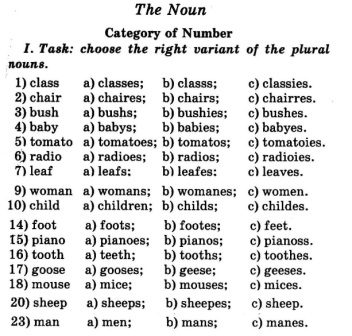
ОБРАЗОВАНИЕ МНОЖЕСТВЕННОГО ЧИСЛА СУЩЕСТВИТЕЛЬНЫХ


Просмотрите видео выше и выполните упражнения с картинок ниже, выучите эти слова!!!


РАЗРЯДЫ МЕСТОИМЕНИЙ


ЛИЧНЫЕ:


ПРИТЯЖАТЕЛЬНЫЕ:


УКАЗАТЕЛЬНЫЕ:


среда, 20 мая 2015 г.

ГОСПОДА СТУДЕНТЫ ВЕЧЕРНЕГО ОТДЕЛЕНИЯ!!!
Те, кто ходил на занятия, и те, кому некогда! просмотрите страничку и выполните задания, данные ниже!
Список устных тем для подготовки к экзамену:
The Earth
People and nature
Habitats in danger
Ecological problems
Environmental problems
The types of pollution
Health effects of pollution
Alternative energy
Water pollution
Air pollution
Soil pollution
Overpopulation
Global warming
Ozone layer
Greenhouse effect
Acid rain
Deforestation
Non-governmental organization
Еще подготовьте по 2 презентации на любую из заданных тем и сдайте до 1 июня!!! 

четверг, 26 февраля 2015 г.

DISASTERS


Чтобы узнать все о стихийных бедствиях/natural disasters, ПЕРЕЙДИТЕ ПО ССЫЛКЕ:

Researchers have been studying disasters for more than a century, and for more than forty years disaster research. The studies reflect a common opinion when they argue that all disasters can be seen as being human-made, their reasoning being that human actions before the strike of the hazard can prevent it developing into a disaster. All disasters are hence the result of human failure to introduce appropriate disaster management measures. Hazards are routinely divided into natural or human-made, although complex disasters, where there is no single root cause, are more common in developing countries. A specific disaster may spawn a secondary disaster that increases the impact. A classic example is an earthquake that causes a tsunami, resulting in coastal flooding.

A natural hazard is a natural process or phenomenon that may cause loss of life, injury or other health impacts, property damage, loss of livelihoods and services, social and economic disruption, or environmental damage.
Various phenomena like earthquakes, landslides, volcanic eruptions, floods, hurricanes, tornadoes, blizzards, tsunamis, and cyclones are all natural hazards that kill thousands of people and destroy billions of dollars of habitat and property each year. However, the rapid growth of the world's population and its increased concentration often in hazardous environments has escalated both the frequency and severity of disasters. With the tropical climate and unstable land forms, coupled with deforestation, unplanned growth proliferation, non-engineered constructions which make the disaster-prone areas more vulnerable, tardy communication, and poor or no budgetary allocation for disaster prevention, developing countries suffer more or less chronically from natural disasters. Asia tops the list of casualties caused by natural hazards.

Human-instigated disasters are the consequence of technological hazards. Examples include stampedes, fires, transport accidents, industrial accidents, oil spills and nuclear explosions/radiation. War and deliberate attacks may also be put in this category. As with natural hazards, man-made hazards are events that have not happened—for instance, terrorism. Man-made disasters are examples of specific cases where man-made hazards have become reality in an event.

There are some examples of nayural disasters:


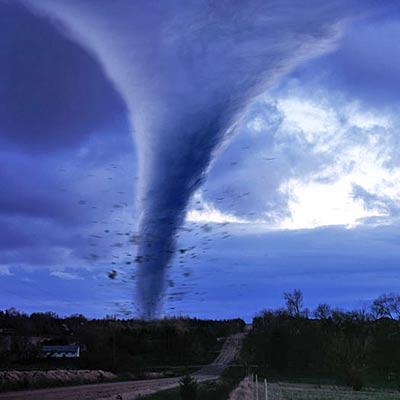
TORNADO

A tornado is a violent, dangerous, rotating column of air that is in contact with both the surface of the earth and a cumulonimbus cloud or, in rare cases, the base of a cumulus cloud. 


EARTHQUAKE:

An earthquake is the result of a sudden release of energy in the Earth's crust that creates seismic waves. At the Earth's surface, earthquakes manifest themselves by vibration, shaking and sometimes displacement of the ground. The vibrations may vary in magnitude. Earthquakes are caused mostly by slippage within geological faults, but also by other events such as volcanic activity, landslides, mine blasts, and nuclear tests.


TSUNAMI
Tsunami is a long high sea wave caused by an earthquake or other disturbance. It Is an extremely large wave caused by a violent movement of the earth under the sea


DROUGHT

Drought is a long period when there is no rain and people do not have enough water. The absence of rain causes fail of crops and death of livestock.


FLOODS

A flood is an overflow of water that submerges land. The EU Floods directive defines a flood as a temporary covering by water of land not normally covered by water.Flooding may result from the volume of water within a body of water, such as a river or lake, which overflows causing the result that some of the water escapes its usual boundaries.


FAMINE 

Famine is a  lack of food for a long time in a particular place. Drought could result in famine throughout the region.


Look the video and retell it:


четверг, 12 февраля 2015 г.

ECOLOGICAL PROBLEMS


Make some  presentations for the themes: 

"Ecological problems" 
"The global problems of mankind" 
"Climate changes"
"Overpopulation"
"Natural sources of energy"


Make such sсheme in English: 


среда, 11 июня 2014 г.

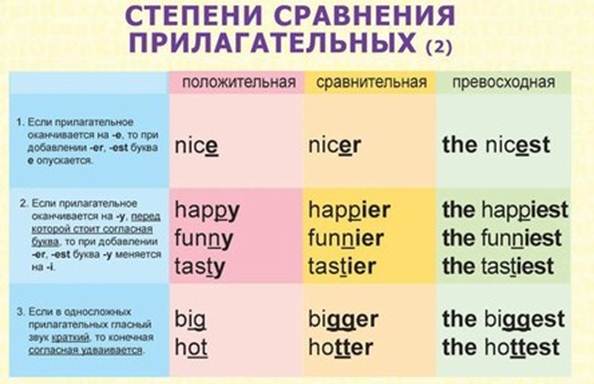
Прилагательные в английском языке

перейдите по ссылке и прочитайте о степенях сравнения прилагательных!!!

Выполните задание:


 1.  The traffic is ..... downtown than on this road, especially during rush hours.  
heavier
the heaviest
heavy
 2.  I don't know much but he knows ..... than I do.  
less
even little
even less
 3.  Susan is better-looking than Ada; however, Liz is ..... one.  
the best-looking
better-looking
good-looking
 4.  I like skiing ..... as skating.  
more
as much
as more
 5.  Philip is so quiet and obedient He is ..... child I have ever met.  
well-behaved
the best-behaved
better-behaved
 6.  I am sure a trolleybus is ..... a metro.  
as convenient as
not as convenient as
more convenient as
 7.  Some students are ..... about their homework as others.  
more serious
not serious
not as serious
 8.  "This is ..... place to cross the street in," the policeman warned us.  
more dangerous
the most dangerous
so dangerous
 9.  Peter, you are ..... than I thought you to be.  
even lazier
as lazy as
more lazier
 10.  Paul is very smart; in fact he is ..... boy among his classmates.  
more intelligent
the most intelligent
as intelligent
 11.  This dress is ..... expensive than that one.  
a bit less
the least
not so
 12.  The nights in summer are ..... the nights in winter.  
not as long as
as long as
longer
 13.  Jim is not very tall. His brother Alec is ..... .  
as tall
taller
the tallest
 14.  I want you to read ..... passage of the text.  
the next
the nearest
next
 15.  Her illness was ..... than we at first had thought.  
the most serious
not as serious
far more serious

Существительные в английском языке

перейдите по ссылке и прочитайте информацию Существительные в английском языке
Выполните письменное задание:

1.  He was very keen that we kept in touch and for that reason he handed me his business .....  
ticket
paper
card
notice

 2.  He didn't hesitate to tell me that I wasn't wanted and just told me to ..... my own business.  
concern
look after
tend to
mind

 3.  Shortly after he was dismissed from the firm he decided to ..... himself up in his own business.  
put
set
place
hold

 4.  I've warned you before that you shouldn't get involved in this matter and you have ..... business discussing it.  
some
little
no
not

 5.  That's really not my concern at all and I'm certainly not ..... the business of telling others what to do.  
in
out
of
by

 6.  I'm afraid it won't be possible to talk to the boss today because he's away ..... business till Tuesday.  
off
on
for
to

 7.  This is the really important part of the machine and that's why we call it the business .....  
centre
end
area
point

 8.  I would ask you kindly not to interfere with what I'm doing as in all honesty it's ..... of your business.  
no
nothing
none
nor

 9.  The whole site has nothing but offices and administration centres and that's why we call it a business .....  
place
situation
field
park

 10.  She knew that there was some kind of ..... business going on because strange things were happening.  
weird
unusual
funny
stupid
МЕСТОИМЕНИЯ-PRONOUNS:
перейдите по ссылке и прочитайте информацию о местоимениях английского языка!
выполните в тетрадях следующее задание:

К каждому вопросу даны несколько вариантов ответа. Выберите тот, который считаете правильным. Если Вы затрудняетесь с ответом, просто пропустите вопрос.

 1.  Is this camera .....?
yours
your
you

 2.  I gave her my address and she gave me ..... .
she
her
hers

 3.  Where are the keys? I can’t find ..... .
they
them
their

 4.  That is not my umbrella; ..... is yellow.
my
mine
me

 5.  They invited ..... to their party. Did they invite you?
us
our
ours

 6.  Why not speak to Jenny and ask ..... for advice?
she
her
hers

 7.  My textbook is at home today. Will you, please, give me .....?
yours
your
you

 8.  Jane’s friends are very kind people; ..... will help her.
they
them
their

 9.  I don’t know these girls. Do you know .....?
them
they
their

 10.  My room is bigger than hers, but ..... is nicer.
she
her
hers

 11.  I can’t find ..... textbook. Have you seen it anywhere?
my
mine
me

 12.  Don’t keep the children indoors in this fine weather; let ..... go for a walk.
they
them
their

 13.  This is not my pencil; ..... is blue.
my
mine
me

 14.  Where is Jane? I want to talk to ..... .
she
her
hers

 15.  ..... invited her to stay with us in our house.
We
Us
Our

 16.  The police say that the man shot ..... with a gun.  
heself
himself
hisself
 
 17.  Did you go on holiday alone? – Yes, I went ..... .  
myself
meself
by myself
 
 18.  Are you ..... better today?  
feeling yourself
feeling yourselves
feeling
 
 19.  I don’t want you to pay for my meal. I can do it ..... .  
myself
meself
by myself
 
 20.  The pan is very hot. Don’t burn ..... .  
youself
yourselves
yourself
 
 21.  Alice never goes to the hairdresser; she cuts her hair ..... .  
sheself
herself
herselves
 
 22.  Don’t bother to ask him. I will do it ..... .  
myself
meself
by myself
 
 23.  Silvia couldn’t get into the house; she had locked ..... out.  
herself
by herself
it
 
 24.  If we believe in ....., we can accomplish our goals.  
ourselves
ourself
myself
 
 25.  When I saw Jim, he was standing in the corner ..... .  
heself
himself
by himself
 
 26.  Please help ..... to some cakes, children!  
youself
yourselves
yourself
 
 27.  Paul had a wash and dried ..... with a towel.  
heself
himself
hisself
 
 28.  The room was almost empty. The only furniture was a table which stood ..... in a corner.  
by itself
itself
himself
 
 29.  Be careful! The knife is very sharp. You may cut ..... .  
youself
yourselves
yourself
 
 30.  Leo and you did a good job; you should be proud of ..... .  
yourselves
yourself
themselves

Эти задания  также выполните в тетрадях:
1.  ..... was a big fire in this building in 1936.  
It
They're
There
Their
 
 2.  Thanks for taking me out, it's much better ..... listening to my grandma all day long.  
than
then
there
it
 
 3.  Mariinsky Theater has gathered the most talented actors ..... art is admired all over the world.  
who's
whose
its
their
 
 4.  Nancy is more ..... a mere dressmaker, she's an artist.  
than
then
there
it
 
 5.  There's plenty of room for cars in the yard; much better ..... parking in the village street.  
than
then
there
it
 
 6.  ..... love grew stronger by the day and then Maisie was born, a healthy, cute baby.  
Its
It's
There
Their
 
 7.  Please send us ..... comments and suggestions.  
then
there
your
you're
 
 8.  My grandfather, ..... house was destroyed in bombing, has never complained about it.  
who's
whose
its
their
 
 9.  These 2 kinds of wallpaper look great but ..... rather expensive too.  
it's
there
their
they're
 
 10.  ..... heartbreaking when families fight over money.  
Its
It's
There
Their
 
 11.  Traffic is a big problem in London which is full of people ..... homes and families can be located quite far away.  
who's
whose
its
their
 
 12.  We must analyse all information and only ..... making any conclusions.  
than
then
there
it
 
 13.  ..... are many interesting places to visit in St. Petersburg.  
Its
It's
There
Their
 
 14.  "Sorry but ..... too late," he told me. "The meeting's over."  
then
there
your
you're
 
 15.  The team is run by a group of 40 people, ..... love of the game has inspired them to establish a well-organised and competitive club.  
who's
whose
its
their